
As the RWA and tokenized stock markets evolve, an increasing number of traditional equities, ETFs, and real-world assets are making their way into crypto as tokens. Users are no longer limited to trading BTC, ETH, meme coins, or DeFi tokens—they can now gain on-chain price exposure to real-world assets using USDT.
ALABB has emerged as a point of interest in this context. For first-time searchers asking “What is ALABB?”, “ALABB crypto”, “ALABB token”, or “ALABB stock”, the most critical question isn’t whether it will go up—it’s first understanding: Is ALABB a regular cryptocurrency or a tokenized asset? Does it represent a real underlying asset? How does its price correlate with the real-world market? How do you buy ALABB? And what are the risks?
A quick caveat: there may be similarly named or differently tickered Alibaba-related tokenized assets in the market. For instance, Hibt previously announced the listing of Alibaba Tokenized bStocks under the ticker BABAB, and CoinGecko lists Alibaba bStocks Tokenized Stock as a tradable tokenized equity. Therefore, before trading ALABB, investors must verify Hibt’s official ticker page, trading pair name, underlying asset description, and platform announcements to avoid confusing different tokens.
1. What Is ALABB? Why Are Traditional Assets Appearing in Crypto?
This section answers the first-time user’s core question: “What exactly is ALABB? Is it a coin or a stock?”
ALABB can be understood as a tokenized asset linked to a traditional asset. It is not a native cryptocurrency like Bitcoin, nor a smart-contract platform asset like Ethereum, nor a meme token.
More precisely, ALABB is a digital representation of a real-world asset within the crypto market.
If ALABB corresponds to Alibaba-related exposure, its core logic is not “issuing a new coin” but enabling investors to gain exposure to Alibaba stock or related market prices through crypto trading methods.
Such assets typically fall under RWA (Real World Assets) . RWA means expressing real-world assets—stocks, ETFs, bonds, commodities, funds, or corporate equity—via blockchain or digital asset platforms, allowing crypto users to trade and allocate in a familiar way.
So, ALABB is not a traditional crypto project; it’s closer to:
- Tokenized Asset
- Blockchain-based financial asset
- RWA-related asset
- Alibaba-related market exposure
- A gateway for crypto users to access traditional assets
2. Why Are Real-World Assets Becoming Tokenized?
Traditional financial investing usually requires a securities account, regional eligibility, trading hours, brokerage systems, clearing processes, and fiat on-ramps.
For example, to invest in Alibaba stock traditionally, the typical path is:
Open a brokerage account → Meet regional & identity requirements → Deposit funds → Trade on a securities exchange during market hours
Tokenized assets attempt to offer an alternative route:
Real-world asset → On-chain or platform mapping → USDT or crypto trading pair → Global user participation → More flexible trading hours and capital flows
Potential advantages of tokenization include:
- Extended trading hours, even near 24/7 availability.
- Lower barriers for some users to access traditional asset markets.
- Bringing stocks, ETFs, commodities, etc., into the crypto trading environment.
- Integration with DeFi, lending, collateralization, liquidity pools, and other on-chain financial applications.
But beginners must understand: tokenization does not equal zero risk, nor does it automatically confer traditional equity rights. It merely changes how the asset is represented and traded.
3. How Is ALABB Different from Ordinary Crypto Tokens?
This section clarifies: What makes ALABB different from BTC, ETH, or meme coins?
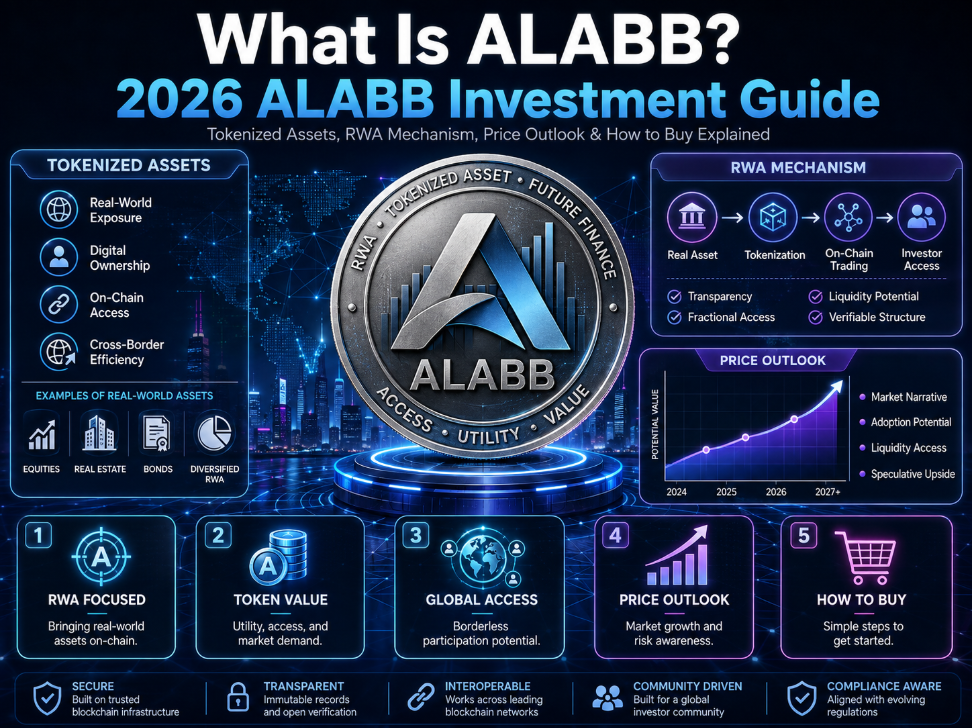
The value of an ordinary crypto token usually stems from blockchain network usage, protocol revenue, user growth, community consensus, on-chain applications, or market narratives.
For example, ETH’s value comes from Ethereum network usage, gas demand, DeFi ecosystem, Layer 2 developments, and fee-burning mechanisms.
Meme token value is largely driven by community propagation, market sentiment, and liquidity.
DeFi token value derives from protocol usage, TVL, trading volume, fees, and governance mechanisms.
But ALABB—a tokenized asset—is different. Its core value typically comes from the performance of the underlying asset, not purely on-chain community hype.
If ALABB represents Alibaba-related price exposure, investors need to research:
- Alibaba’s business performance
- E-commerce, cloud computing, AI, and international business trends
- Valuation changes
- The Chinese ADR market environment
- Whether the token accurately tracks the asset price
- Custody and redemption mechanisms
- Exchange liquidity
- Regulatory restrictions
This is the key distinction: tokenized assets lean on real-world asset value, while ordinary crypto tokens lean on blockchain network value and market consensus.
4. The Asset Logic Behind ALABB: What Value Does It Represent?
Before investing in ALABB, you must answer three questions.
First, what is the underlying asset?
What exactly does ALABB represent? Is it Alibaba stock, an Alibaba-related tokenized stock, or merely a synthetic asset tracking Alibaba’s price movement?
Second, what is the ownership structure?
When you hold ALABB, do you own real equity rights? Do you receive dividends? Do you have voting rights? Can you redeem it for the underlying stock? Or do you only gain price exposure?
CoinMarketCap’s description of Alibaba Tokenized bStocks notes that such assets offer price exposure, dividends, and 1:1 conversion rights to the underlying stock—but specific rights still depend on the issuer and platform rules. This shows that tokenized stock structures can be far more complex than typical crypto tokens.
Third, how is price tracking implemented?
Is ALABB’s price maintained through real asset reserves, market-maker quotes, arbitrage mechanisms, issuance/redemption processes, or platform order matching?
If these questions remain unclear, you cannot simply equate ALABB with the actual stock.
5. How Does a Tokenized Asset Capture Value?
The value-capture logic of a tokenized asset usually comes from the connection between the underlying asset and market demand.
- If the underlying asset rises, the token price should theoretically rise.
- If market demand for that asset class increases, trading liquidity improves, and the token price moves closer to fair value.
- If the token can be used for collateral, lending, liquidity provision, or DeFi composability, its use cases expand.
A simplified model:
Traditional stock value growth → Tokenized asset tracks price → Crypto market trading demand increases → Liquidity improves → Token price reflects asset value
But this is an ideal model. In reality, token prices may deviate from the underlying asset due to insufficient liquidity, exchange differences, regional restrictions, custody risks, or regulatory changes.
Thus, analyzing ALABB requires more than looking at the chart—you must examine the asset structure.
6. Why Are Crypto Investors Paying Attention to RWA?
Historically, crypto markets primarily traded native digital assets—BTC, ETH, DeFi tokens, and memes. Now, attention is shifting to RWA—real-world assets on-chain.
RWA is gaining traction because it addresses a long-standing issue: while on-chain assets are highly innovative, the share that truly connects to real-world cash flows, corporate value, commodity prices, and financial instruments remains limited.
RWA allows crypto markets to connect with more real-world assets: stocks, bonds, funds, treasuries, commodities, real estate, and corporate income rights.
For example, What is FXRP demonstrates how XRP can be mapped into DeFi financial systems. Although FXRP is not a traditional equity RWA, it illustrates a common trend: assets are moving beyond mere holding and trading into lending, collateralization, liquidity, and financial composability.
If ALABB represents an Alibaba-related tokenized asset, it belongs to this broader trend of asset financialization.
7. ALABB Tokenomics: Supply, Liquidity, and Trading Mechanisms
This section addresses: How does this asset trade?
Tokenized assets differ from typical project tokens. Ordinary project tokens may have fixed total supply, team allocations, community incentives, staking rewards, and governance mechanisms.
For ALABB, you need to focus on three things:
1. Token Supply
Is the supply fixed? Is it dynamically issued based on underlying asset demand? Is each token backed by a corresponding reserve of the underlying asset?
2. Issuance Model
How are new ALABB tokens created? Can users subscribe through the platform? Is there a primary-market minting mechanism, or can tokens only be traded on secondary markets?
3. Redemption Mechanism
Can users redeem ALABB for the underlying stock or cash equivalents? Are there restrictions? Is redemption limited to accredited investors? Is it affected by regional regulations?
These questions determine whether ALABB is a “genuinely asset-backed tokenized asset” or merely a “price-tracking synthetic asset.”
8. How Does ALABB Maintain Price Alignment with the Underlying Asset?
Tokenized assets typically rely on three mechanisms to maintain price correlation:
1. Asset Reserves
If each token is backed by actual stock or equivalent assets in custody, the market is more likely to trust that the token price should approximate the underlying asset.
2. Arbitrage Mechanisms
If the token trades below the underlying asset, arbitrageurs may buy tokens and profit via redemption. If the token trades above, they may issue or sell tokens to reduce the premium.
3. Issuance and Redemption
The smoother the issuance and redemption process, the closer the token price will track the underlying asset. If redemption is restricted, custody is opaque, or only available to certain users, price deviations may widen.
Therefore, when investing in ALABB, don’t just check the “ALABB price”—also assess whether ALABB effectively tracks the underlying asset.
9. How Does Liquidity Affect Investment in ALABB?
Liquidity is a critical risk factor in tokenized asset investing.
If an asset looks price-stable but has very low volume, you may face high slippage when actually buying or selling.
If order-book depth is shallow, your executed price may differ significantly from expectations.
If the asset is supported on few exchanges, exiting may be challenging.
Investors should monitor:
- Trading volume
- Market depth
- Exchange support
- Bid-ask spread
- Presence of market makers
- Availability of stablecoin trading pairs
- Support for withdrawals or on-chain transfers
For assets like ALABB, stronger liquidity means prices more accurately reflect underlying value; weaker liquidity means greater risk of deviation.
10. How to Buy ALABB: A Beginner’s Step-by-Step Guide
Step 1: Confirm official asset information.
Before purchasing, verify that ALABB is officially listed on Hibt or other platforms, that the trading pair is ALABB/USDT, and that the underlying asset description is clear. Due to the existence of Alibaba-related tokenized stocks under different tickers, always rely on official announcements and ticker pages.
Step 2: Prepare a trading account or crypto wallet.
If ALABB is listed on a centralized exchange, register an account, complete security settings, and perform identity verification as required.
If ALABB trades on a decentralized exchange (DEX), prepare a wallet supporting the relevant network and confirm the contract address.
Step 3: Prepare USDT or ETH.
Many tokenized assets trade against USDT. For on-chain assets, you may also need ETH or the network’s native gas token for fees.
Step 4: Search for the ALABB trading pair.
On the exchange, search for “ALABB” or “ALABB/USDT”. Before placing an order, check the asset name, icon, underlying asset description, trading depth, and price history to avoid buying a similarly named or incorrect asset.
Step 5: Complete the purchase.
Beginners are better off using limit orders rather than market orders. Tokenized assets can experience slippage when liquidity is low; limit orders give you better control over execution price.
Step 6: Confirm storage method.
If purchased on an exchange, assets are typically held in your platform account. If withdrawals to an on-chain wallet are supported, verify the network, contract address, and wallet compatibility.
11. How to Check ALABB Real-Time Quotes?
Users can view ALABB market data via Hibt’s quotes page. Upon official release, use the corresponding ticker page:
The quotes page should show:
- Current price
- 24h change
- Trading volume
- Market depth
- Historical trends
- Related trading pairs
If the quotes page is not yet live, confirm the actual URL, ticker symbol, and underlying asset name match ALABB before publication.
12. ALABB Price Prediction: How to Analyze Future Value?
ALABB price prediction cannot be reduced to a single fixed number. The price of a tokenized asset must be analyzed by combining the underlying asset, market liquidity, crypto cycles, and the regulatory environment.
Users can refer to ALABB Price Prediction for trend references, but no prediction replaces fundamental research.
Three main categories of factors influence ALABB’s price:
1. Asset factors
If ALABB corresponds to Alibaba-related assets, underlying performance is key. Track Alibaba’s e-commerce, cloud computing, AI investments, international business, profit margins, valuation changes, and the Chinese ADR market environment.
2. Market factors
Crypto market cycles, RWA sentiment, stablecoin liquidity, exchange support, and investor risk appetite affect short-term price.
3. Regulatory factors
Tokenized stocks and RWA assets are subject to securities regulations, regional restrictions, custody rules, and disclosure requirements. Tighter regulation may restrict trading; clearer regulation may attract institutional participation.
13. Bull Case: Optimistic Scenarios for ALABB
In an optimistic scenario, ALABB could benefit from:
1. Growth of the RWA market – As more stocks, ETFs, and real-world assets enter crypto, tokenized assets gain user understanding and trading demand.
2. Increased institutional adoption – Clearer compliance pathways encourage institutional capital to participate, improving liquidity.
3. Stronger underlying asset performance – If Alibaba-related fundamentals improve and valuations rise, ALABB as a related tokenized asset may gain price support.
4. Enhanced liquidity – If ALABB lists on more platforms, trading depth improves, bid-ask spreads narrow, and participation barriers lower.
14. Bear Case: Risk Scenarios for ALABB
In a pessimistic scenario, ALABB could face:
1. Regulatory restrictions – Tokenized stocks carry securities attributes; different jurisdictions may restrict retail trading.
2. Insufficient liquidity – Low trading volume may cause price deviations from the underlying asset and difficulty in buying or selling.
3. Decline in the underlying asset – If Alibaba-related stocks or assets perform poorly, ALABB’s price may suffer.
4. Opaque asset structure – If it’s unclear whether ALABB has real asset backing, custody arrangements, or redemption mechanisms, investor confidence may erode.
5. Crypto market downturn – Even if the underlying asset is stable, a drop in crypto risk appetite may affect trading demand for ALABB.
15. ALABB and the Tokenization Trend of Brand Assets like POPMART
POPMART offers an interesting comparison. It represents a consumer brand and IP-economy asset. You can observe its market performance via POPMART Real-Time Quotes and understand brand-asset price analysis through POPMART Price Prediction.
POPMART’s value comes from IP assets, community engagement, consumption growth, and global expansion.
If ALABB represents Alibaba-related assets, its value leans more toward e-commerce, cloud computing, technology platforms, and corporate fundamentals.
Both are representative cases of real-world assets entering crypto, but their investment logic differs:
- POPMART is more about consumer brand and IP economics.
- ALABB is more about tech platforms and equity-like exposure.
The commonality: you cannot judge either solely by token price—you must also examine underlying enterprise value, asset structure, liquidity, and regulatory frameworks.
16. ALABB and the Future of RWA
In the future, RWA could cover many more asset types:
- Stocks can be tokenized.
- ETFs can be tokenized.
- Funds can be tokenized.
- Commodities can be tokenized.
- Real estate can be tokenized.
- Brand assets and IP royalties may also be tokenized.
ALABB represents the direction of bringing listed-company assets into crypto trading environments. Its significance is not just adding another trading pair—it expands crypto markets from “trading native tokens only” to “trading exposure to real-world assets.”
However, for this path to mature, legal, custody, redemption, auditing, exchange compliance, and investor protection issues must be resolved.
17. What Is the Relationship Between ALABB and the Ethereum Ecosystem?
Many tokenized assets rely on Ethereum because it offers a mature smart-contract ecosystem, DeFi protocols, stablecoin liquidity, institutional acceptance, and developer tooling.
Many tokenized assets choose to deploy on Ethereum, Base, BNB Chain, or other EVM-compatible networks because these ecosystems integrate easily with DEXs, lending protocols, custody tools, and wallets.
Users can refer to ETH Price Prediction to observe how the Ethereum ecosystem influences RWA, DeFi, and tokenized asset markets.
The typical path for tokenized assets into DeFi is:
Real-world asset → Tokenization → Ethereum or Layer 2 → DEX trading → Lending collateral → Financial composability → Global liquidity
If ALABB supports on-chain transfers, collateralization, or lending in the future, its utility expands from pure trading to DeFi composability. If it only trades within a centralized platform, it remains a platform-based tokenized asset rather than a fully open on-chain asset.
18. ALABB Investment Risk Analysis: What Must You Know Before Investing?
1. Regulatory risk – Tokenized assets involve securities regulation, compliance, investor suitability, and regional restrictions. Users in certain countries may be unable to trade, or their rights may be limited.
2. Asset authenticity risk – Verify whether ALABB has real asset backing, custody proof, third-party audits, and public reserve disclosures. If unconfirmed, do not treat it as equivalent to actual stock.
3. Price-tracking risk – ALABB’s price may deviate from the underlying asset, especially during low liquidity, redemption restrictions, different trading hours, or high volatility.
4. Liquidity risk – Insufficient trading volume may make it hard to buy or sell quickly, or cause wide spreads.
5. Platform risk – If ALABB is only available on a specific exchange, you bear risks of platform custody, rule changes, trading halts, withdrawal restrictions, and regional blocks.
6. Crypto security risk – Beyond returns, consider wallet security, private key management, and asset custody. You can read Coldcard Hack Explained to understand why hardware wallets, seed phrases, contract addresses, and asset migration processes are critical for crypto investing.
19. Comparing ALABB’s Investment Logic with Other Crypto Assets
- AI Crypto focuses on artificial intelligence, data, computing power, and automation. For example, What is AIRH represents AI Robotics combined with asset tokenization.
- Web3 project tokens focus on ecosystem and user growth. What is FRONG is better analyzed from a small-cap, community-driven, liquidity, and early-stage risk perspective.
- Infrastructure assets focus on network growth and tokenomics. Solana Inflation Mechanism Explained details SOL’s supply schedule, inflation, burn mechanisms, and token economics.
ALABB is distinct from all of these. Its core logic leans toward RWA and tokenized stocks. Investors need both traditional stock analysis skills and crypto risk awareness.
20. How to Judge Whether ALABB Is Worth Investing In?
Assess ALABB on three levels:
Level 1: Asset Value
- Check what the underlying asset is.
- Confirm whether it corresponds to Alibaba-related assets.
- Evaluate whether the corporate fundamentals are sound.
- Verify whether the price-tracking mechanism is clear.
- If the underlying asset is unclear, do not take a heavy position.
Level 2: Token Structure
- Is the issuance mechanism transparent?
- Is there real asset backing?
- Is there a redemption mechanism?
- Is trading liquidity sufficient?
- Are there regulatory restrictions?
- The more opaque the token structure, the higher the investment risk.
Level 3: Market Trends
- Is the RWA market growing?
- Are institutions participating in tokenized assets?
- Is crypto in a liquidity-upcycle phase?
- Is sentiment improving for Chinese ADRs and tech stocks?
- Only when asset value, token structure, and market trends are all favorable does ALABB’s investment thesis become clearer.
21. Suggested Additional Data Modules
To enhance E-E-A-T, consider adding the following modules:
Asset Analysis – Display ALABB’s underlying asset, asset type, market value, price-tracking method, and redemption availability.
Core takeaway: investors must first know exactly what they are buying.
Token Analysis – Show supply, circulating supply, holder count, major exchanges, trading volume, and market depth.
Core takeaway: token structure determines liquidity and price stability.
Price Tracking – Show the deviation between ALABB’s price and the underlying asset.
Core takeaway: one of the most important questions for a tokenized asset is whether it effectively tracks the underlying.
Risk Analysis – Show regulatory, market, technical, custody, and liquidity risks.
Core takeaway: RWA assets are not risk-free—they combine traditional financial risks with crypto risks.
22. FAQ: Common Questions About ALABB
What is ALABB?
ALABB is a blockchain-based asset representation designed to connect traditional assets with crypto markets. If it corresponds to Alibaba-related assets, it is better understood as a tokenized asset or RWA asset, not a native cryptocurrency.
Is ALABB a cryptocurrency?
That depends on the asset structure. ALABB can be traded in crypto markets, but it is unlike Bitcoin or Ethereum. It is closer to a tokenized asset—a digital expression of a real-world asset on-chain or on a trading platform.
How is ALABB different from ordinary stock?
Ordinary stock is typically traded through securities accounts, and holders may have shareholder rights, dividends, or voting rights. ALABB—as a tokenized asset—may only provide price exposure or on-chain representation. Whether it confers actual rights depends on the issuer, custody, redemption, and platform rules.
How to invest in ALABB?
Users can buy through platforms that support ALABB. Before buying, confirm the trading pair, underlying asset description, official announcements, and risk disclosures. Monitor market data via ALABB Real-Time Quotes.
How to read ALABB price predictions?
ALABB price predictions should combine underlying asset performance, RWA market heat, trading liquidity, regulatory environment, and crypto cycles. You can refer to ALABB Price Prediction, but never treat predictions as guaranteed returns.
Is ALABB a good investment?
That depends on the underlying asset, valuation levels, token structure, liquidity, and regulatory environment. If ALABB cannot clearly explain its asset backing and rights structure, investment risk increases significantly.
Where does ALABB’s future potential come from?
Future potential comes from RWA market growth, Alibaba-related asset performance, increased liquidity for tokenized assets, institutional adoption, and crypto capital inflows.
23. Conclusion: Is ALABB Worth Investing In?
ALABB is worth paying attention to, but it should not be simplistically viewed as “Alibaba stock on-chain, therefore it will go up.”
Its value logic:
- ALABB may represent a form of traditional assets entering crypto markets.
- It aligns with the RWA and tokenized asset trend.
- It gives crypto users an opportunity to gain exposure to traditional assets via USDT or digital asset platforms.
If the underlying asset is clear, custody is transparent, and liquidity is healthy, ALABB could become an important case of real-world assets moving on-chain.
But its risks are equally apparent:
- Whether ALABB represents a real asset requires official confirmation.
- Tokenized assets may not equal real equity rights.
- Regulatory restrictions may affect trading and redemption.
- Insufficient liquidity may cause price deviations.
- Platform custody and crypto security risks cannot be ignored.
For beginners, the three most important things before investing in ALABB are:
- Confirm the underlying asset – What exactly does it correspond to? Is it Alibaba stock or a related asset?
- Confirm the token structure – Is it backed by real assets? Is it redeemable? Or is it merely a synthetic price?
- Confirm market risks – Do RWA sentiment, crypto cycles, liquidity, and the regulatory environment support the current price?
A more rational approach: start by checking ALABB Real-Time Quotes to understand market performance, then combine with ALABB Price Prediction, POPMART Real-Time Quotes, POPMART Price Prediction, What is FXRP, ETH Price Prediction, What is AIRH, What is FRONG, and Solana Inflation Mechanism Explained to build a complete analytical framework for RWA and crypto assets.
ALABB’s long-term investment value ultimately depends not on a trendy name, but on whether the underlying asset is real, whether the token structure is transparent, whether market demand exists, and whether the regulatory environment allows RWA assets to continue expanding. For investors, RWA is an opportunity—but also a more complex combination of risks.