
Written by Hibt Crypto Research Team
Updated: August 2026
For years, U.S. cryptocurrency regulation has been stuck on a fundamental question: Who should oversee crypto?
The SEC?
The CFTC?
Is a given token a security, a commodity, or something else entirely?
Should exchanges register as securities trading platforms or as digital commodity trading venues?
That is precisely the problem the CLARITY Act seeks to solve.
In short, the CLARITY Act is a U.S. crypto market structure bill designed to establish clearer rules for digital assets—above all, by defining the respective roles of the SEC and CFTC in crypto oversight. According to the Congress.gov summary of H.R. 3633, the bill establishes a regulatory framework for digital commodities and directs the CFTC to generally oversee digital commodity transactions, including digital commodity exchanges, brokers, and dealers.
As of August 5, 2026, the CLARITY Act passed the U.S. House of Representatives on July 17, 2025, by a vote of 294–134, but it has not yet become law; Congress.gov shows the bill was referred to the Senate Committee on Banking, Housing, and Urban Affairs. Recent market attention is focused on whether the Senate can move the bill forward, and whether disputes over consumer protection, banking interests, stablecoin yields, and political ethics provisions can be resolved.
1. What Is the CLARITY Act?
This section answers: What exactly is the CLARITY Act?
In one sentence:
The CLARITY Act is a proposed U.S. cryptocurrency regulation framework designed to establish clearer rules for digital assets, including the regulatory responsibilities of the SEC and CFTC.
Its formal title is the Digital Asset Market Clarity Act of 2025. The Congress.gov summary explicitly states that it creates a regulatory framework for “digital commodities,” defined as digital assets that derive value from a blockchain.
For everyday investors, think of the CLARITY Act as a potential “rulebook” for U.S. crypto markets.
It aims to answer four questions:
- Who regulates crypto?
- Which tokens are securities?
- Which tokens are commodities?
- How do trading platforms operate in compliance?
That is why it is often called a “crypto market structure bill.”
2. Why Does the U.S. Need a New Crypto Framework?
This section answers: Why does the crypto industry care so much about this bill?
The biggest problem in U.S. crypto regulation has been regulatory uncertainty. Many project founders do not know whether their token is a security; exchanges are unsure which assets they can list; and institutional investors worry about retroactive enforcement actions.
As the Congressional Research Service noted in its analysis of the CLARITY Act, not all digital assets are legally classified as securities—some may fall under the Commodity Exchange Act as commodities. At the same time, for spot digital assets that are not securities, no federal agency currently has comprehensive general oversight authority.
That is the root of the long-standing confusion.
If a token is deemed a security, it must comply with SEC rules on issuance, disclosure, exchange registration, and investor protection.
If a token is deemed a commodity, it falls more under CFTC jurisdiction—especially for spot markets, derivatives, trading platforms, anti‑manipulation, and anti‑fraud.
But in the past, many tokens sat in a gray area. Project teams, exchanges, investors, and regulators often had different views of the same asset.
The CLARITY Act aims to turn those gray zones into clearer legal pathways.
3. What Core Problems Does the CLARITY Act Address?
The CLARITY Act tackles four main categories of issues.
First: Digital Asset Classification
Is the asset a digital commodity, a digital security, or something else? Classification determines the regulatory regime.
Second: Agency Authority
The SEC oversees securities markets; the CFTC oversees commodities and derivatives. Without clear classification, the boundary between SEC and CFTC jurisdiction remains blurred.
Third: Exchange Framework
How should crypto trading platforms register? How do they protect client assets? What trade surveillance and recordkeeping are required?
Fourth: Consumer Protection
The bill addresses trade monitoring, recordkeeping, segregation of customer assets, anti‑money laundering, and market integrity. The Congress.gov summary explicitly mentions transaction surveillance, recordkeeping, restrictions on commingling customer assets, and compliance with the Bank Secrecy Act for digital commodity exchanges, brokers, and dealers.
So the CLARITY Act is not simply “pro‑crypto” or “anti‑crypto.” It is more like a foundational framework for issuance, trading, custody, clearing, and oversight in U.S. crypto markets.
4. Why Is the CLARITY Act Important for Crypto?
This section answers: Why does the market pay so much attention to this bill?
The reason is simple: regulatory rules affect whether assets can be listed, whether institutions can enter, whether exchanges can operate, whether projects can raise capital, whether ETFs can grow, and whether RWA tokenization can expand legally.
In the past, U.S. crypto markets often operated under “innovate first, enforce later.” After a project launched, regulators might decide years afterward that a token or sales method violated securities laws. That approach was hostile to businesses, exchanges, and investors alike.
- For businesses: the biggest issue was not knowing how to comply.
- For exchanges: the biggest issue was not knowing which tokens could be listed.
- For investors: the biggest issue was not knowing whether an asset might be delisted or lose liquidity due to future regulatory rulings.
- For institutions: the biggest issue was the lack of a clear compliance framework.
If the CLARITY Act becomes law, it could shift U.S. crypto markets from an enforcement‑driven model to a rules‑driven one.
That is why it matters for BTC, ETH, ETFs, RWA, DeFi, and emerging tokens alike.
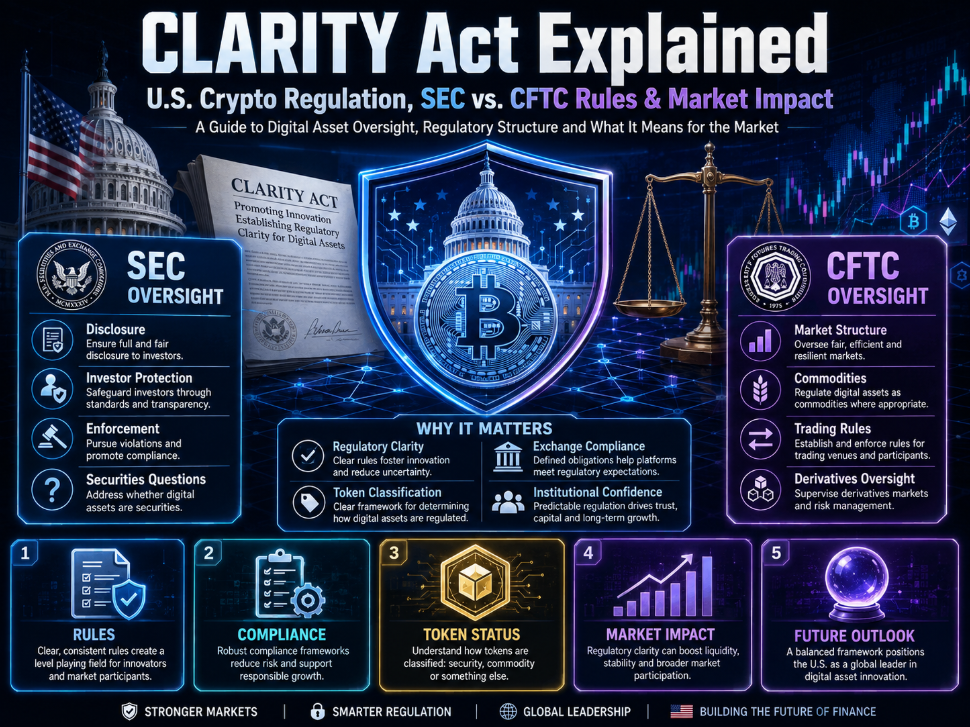
5. SEC vs. CFTC: Why Jurisdiction Is the Biggest Flashpoint
This section is SEO‑focused, with core keywords: SEC vs CFTC crypto, SEC crypto regulation, CFTC crypto regulation.
The SEC (Securities and Exchange Commission) primarily oversees securities, investment contracts, securities trading, broker‑dealers, investment advisers, national securities exchanges, and investor protection. The CRS notes that the existing SEC securities framework is technology‑neutral—meaning that if an asset or transaction falls under securities laws, those laws apply regardless of whether the form is traditional or digital.
The CFTC (Commodity Futures Trading Commission) primarily oversees commodity derivatives, futures, swaps, and related markets. If a crypto asset is classified as a digital commodity, it falls more under CFTC jurisdiction.
The problem: What is a crypto token?
If a token is sold like an investment contract—where buyers expect profits from the efforts of a project team—it may trigger securities law.
If a token runs on a mature, decentralized blockchain and functions more like a digital commodity, it may be closer to CFTC oversight.
The CLARITY Act tries to draw that line more clearly. The Congress.gov summary indicates that the bill requires the CFTC to generally regulate digital commodity transactions, including exchanges, brokers, and dealers, while also preserving SEC jurisdiction over certain digital‑commodity‑related activities and SEC‑registered entities.
Think of it this way:
- SEC focus: securities, investment contracts, disclosure, investor protection.
- CFTC focus: commodities, spot and derivatives markets, trading platforms, market manipulation.
- CLARITY Act focus: which crypto assets fall under which agency, how exchanges register, and how market structure is organized.
6. SEC vs. CFTC: A Side‑by‑Side Comparison
SEC Oversight
CFTC Oversight
Securities
Commodities
Investment Contracts
Digital Commodity Transactions
Disclosure
Derivatives
Investor Protection
Digital Commodity Exchanges
National Securities Exchanges
Digital Commodity Brokers
Broker‑Dealers
Digital Commodity Dealers
The CLARITY Act’s goal:
Not to eliminate the SEC.
Not to give the CFTC full control over all crypto.
Rather, to clarify asset classification, exchange registration, spot market oversight, securities law applicability, and customer protection rules.
That is why “crypto regulation SEC CFTC” is a high‑value search term.
7. What Does the CLARITY Act Regulate? Core Regulatory Provisions
This section answers: What exactly does the CLARITY Act govern?
The primary focus of the CLARITY Act is digital commodities. Under the Congress.gov summary, digital commodities are defined as digital assets that derive value from a blockchain.
But not every token automatically qualifies as a digital commodity. The bill also considers whether the blockchain is mature, whether it meets decentralization criteria, and whether the issuer has filed required reports. The Congress.gov summary notes that for a digital commodity to be traded on an exchange, its blockchain must be mature or meet the bill’s decentralization test; otherwise, the issuer may need to submit specific reports.
This leads to three key classifications:
- Digital Commodities – primarily overseen by the CFTC.
- Securities – overseen by the SEC.
- Mixed Digital Asset Transactions – subject to joint SEC‑CFTC rulemaking.
The bill text also mentions that the SEC and CFTC must jointly issue rules for mixed digital asset transactions.
So the CLARITY Act does not simply hand all crypto to the CFTC; it tries to create a more granular regulatory structure.
8. Why Asset Classification Affects Token Value
Classification directly affects a token’s trading, liquidity, and valuation.
If a token is deemed a security, exchanges may need a securities‑trading registration path; issuers may need disclosure filings; trading eligibility may be restricted; and listing on mainstream venues may become harder.
If a token is classified as a digital commodity and meets the requirements, it may be more readily tradable on regulated digital commodity platforms.
This impacts three areas:
- Compliance costs for projects.
- The less clear the rules, the higher the legal costs and risks.
- Exchange listing barriers.
- Unclear classification makes exchanges hesitant to list.
- Institutional participation.
- Institutional capital needs clear compliance pathways. Without classification, funds, banks, ETF issuers, market makers, and custodians remain cautious.
For example, AI tokens, meme tokens, RWA tokens, and DeFi tokens may face different classification risks. Readers can explore what AIRH is and what FRONG is to understand how different asset types fare under varying regulatory environments.
9. CLARITY Act and Crypto Market Structure: How Will U.S. Crypto Markets Change?
This section answers: What does “market structure” actually mean?
In traditional finance, market structure includes issuance, trading, brokerage, clearing, custody, market making, disclosure, and oversight.
The stock market is not just “buying and selling shares.” It involves exchanges, brokerages, clearinghouses, custodians, disclosure rules, anti‑manipulation rules, and investor protection rules.
Crypto markets have historically been more hybrid.
A single trading platform might simultaneously handle trading, custody, market making, lending, issuance, listing, and wallet services.
This vertical integration is efficient, but it also creates conflicts of interest and customer asset safety concerns.
The “market structure” the CLARITY Act addresses is an attempt to disentangle roles, responsibilities, and regulatory requirements within crypto markets.
In the future, crypto markets may gradually evolve into a clearer chain:
Token Issuance
       ↓
Trading Platforms
       ↓
Custodians
       ↓
Clearing & Settlement
       ↓
Regulatory Rules
       ↓
Investor Protection
The bill also requires the CFTC to issue rules on identifying, mitigating, and resolving conflicts of interest among registered entities and related persons, particularly focusing on conflicts arising from vertically integrated market structures.
This is critically important for exchanges, market makers, custodians, and large crypto firms.
10. How Will the CLARITY Act Affect Crypto Exchanges?
This section answers: What changes are in store for exchanges?
Crypto exchanges are among the most affected entities under the CLARITY Act.
Exchanges handle user funds, trade matching, token listings, market surveillance, asset custody, risk controls, and anti‑money laundering. In the past, the biggest question for many U.S. platforms was: should they register as securities exchanges or as commodity trading venues?
The CLARITY Act aims to provide a registration pathway for digital commodity trading platforms, brokers, and dealers. The Congress.gov summary shows that the bill requires the CFTC to generally regulate digital commodity transactions—including exchanges, brokers, and dealers—and imposes trade surveillance, recordkeeping, customer asset segregation, and AML obligations.
For exchanges, four types of changes may emerge:
- Registration.
- Platforms may need to register under digital commodity exchange, broker, or dealer rules.
- Compliance.
- Exchanges will need clearer AML, customer asset segregation, recordkeeping, and surveillance procedures.
- Listing Standards.
- Token listing criteria may become stricter. Exchanges will need to assess whether an asset qualifies as a digital commodity, whether its blockchain is mature, and whether the issuer has completed required filings.
- Consumer Protection.
- Standards for user asset protection, transparency, conflict‑of‑interest disclosures, and platform accountability are likely to rise.
For ordinary users, this could mean changes in the available trading assets—some tokens may find their way onto compliant platforms more easily, while others may face trading restrictions due to unclear classification.
11. CLARITY Act and Bitcoin / Ethereum: Will BTC and ETH Be Affected?
This section answers: If I hold BTC and ETH, should I be concerned?
Bitcoin has long been widely viewed as closer to a commodity‑like asset. If the CLARITY Act establishes a digital commodity framework, Bitcoin would likely be one of the easiest assets to fit within that logic.
That does not mean BTC’s price will necessarily rise—but it does mean BTC’s regulatory path may become clearer.
Ethereum is more complex.
ETH is both a network asset, a gas token, a PoS staking asset, and a foundation for DeFi, Layer 2, NFTs, stablecoins, and RWA markets. Therefore, regulatory discussions around ETH are more complicated than those for BTC.
In March 2026, the SEC issued an interpretation on the application of federal securities laws to certain types of crypto assets and transactions, stating that one of its goals was to provide clearer token classification; the CFTC joined that interpretation, stating it would apply the Commodity Exchange Act guidance consistently with the SEC’s interpretation.
This shows that U.S. regulators are already trying to provide more explicit classification guidance, and the CLARITY Act seeks to codify that framework into law. Readers can follow ETH price predictions to observe market developments around ETH in light of regulation, ETFs, DeFi, and Layer 2 growth.
For BTC and ETH investors, the CLARITY Act is likely to bring not short‑term price certainty, but long‑term institutional certainty.
The clearer the rules, the easier it becomes for institutional custody, ETF products, derivatives, market making, and large‑scale capital allocation to establish stable pathways.
12. CLARITY Act and Crypto ETFs: How Regulatory Clarity Affects Institutional Capital
ETFs require regulatory certainty.
To bring an asset into the ETF ecosystem, issuers need clear answers on asset classification, custody rules, market surveillance, liquidity sources, trading venues, and risk disclosure standards.
BTC ETFs and ETH ETFs are important precisely because they bring crypto assets into traditional financial product frameworks, allowing institutions and retail investors to gain price exposure through securities accounts.
If the CLARITY Act establishes clearer crypto market structure, it may bring more assets into institutional research pipelines.
Future market discussions may continue around:
- ETH‑related ETFs
- Solana‑related ETFs
- RWA token products
- Commodity token products
- On‑chain yield products
But investors should note: regulatory clarity does not mean every token can launch an ETF. Asset size, liquidity, market surveillance, custody security, manipulation risk, and legal classification all remain critical.
The CLARITY Act’s significance for ETFs is that it may lower the “unclear regulatory path” hurdle—but it does not guarantee approval for any particular token ETF.
13. CLARITY Act and RWA Tokenization: Why Real‑World Assets Need Regulation Most
This section answers: Why does real‑world asset tokenization need legal clarity?
The biggest challenge for RWA is not technology—it is legal attribution.
If a token represents a stock, bond, fund, real estate, Treasury, gold, or other real‑world asset, investors must know:
- What does the token represent?
- Who owns the underlying asset?
- Where is the asset custodied?
- Is there a right of redemption?
- Is there a right to income?
- Who is responsible for disclosure?
- Which country’s laws govern trading?
If these questions are unanswered, RWA cannot be adopted at scale by institutions.
Although the CLARITY Act primarily focuses on digital asset market structure, it has indirect implications for RWA. The clearer the asset classification, custody rules, exchange registration, and market oversight, the easier it is for RWA projects to build compliant products.
For example, what FXRP is shows how XRP can enter DeFi lending and collateralization via Flare FAssets. While FXRP is not a traditional RWA, it illustrates a broader trend: crypto assets are moving beyond simple trading into collateral, lending, liquidity, and financial infrastructure.
The future of crypto markets is not just about token price moves—it is about whether assets can integrate into a more mature financial system.
14. Why Is the CLARITY Act Controversial?
This section answers: Why do some support it while others oppose it?
The CLARITY Act’s controversies stem from three main directions.
First: SEC vs. CFTC Power Allocation.
Supporters argue that clarifying the SEC‑CFTC boundary reduces regulatory uncertainty and helps businesses comply.
Opponents worry that if too many assets are placed under the CFTC’s digital commodity framework, the SEC’s investor protection and disclosure oversight could be weakened.
Second: Consumer Protection.
Supporters believe that clear exchange registration, customer asset rules, and market surveillance help protect users.
Opponents fear the bill may be too lenient on some crypto firms, failing to adequately cover fraud, manipulation, conflicts of interest, and retail investor safeguards.
Third: Federal vs. State Authority.
U.S. financial regulation is itself a federal‑state dual structure. Crypto trading, custody, stablecoins, payments, and securities regulation may simultaneously involve federal oversight, state money‑transmitter licenses, state securities laws, and consumer protection laws.
Recent Senate debates also include political ethics provisions, stablecoin yields, banking concerns, and consumer protection issues. MarketWatch reported in late July 2026 that the bill faces headwinds in the Senate, with disputes centering on ethics clauses, consumer safeguards, and bank worries that stablecoin yields could affect deposits.
This shows that while the bill is named “Clarity,” it is itself subject to complex political negotiations.
15. Crypto Regulation Timeline: U.S. Crypto Oversight Milestones
Early Phase:
Rapid crypto innovation; exchanges, token issuance, DeFi, stablecoins, and NFTs grow quickly. Regulation mainly responds through existing securities, commodities, and enforcement actions.
SEC Enforcement Era:
The SEC uses enforcement cases to clarify which tokens or transactions may be securities. Projects and exchanges face high uncertainty.
Market Structure Reform:
Congress begins pushing for digital asset market structure legislation. The CLARITY Act proposes SEC‑CFTC division, digital commodity platform rules, and registration pathways.
House Passage:
On July 17, 2025, the CLARITY Act passes the House by 294‑134.
Senate Stage:
The bill is referred to the Senate Committee on Banking, Housing, and Urban Affairs; it has not yet become law.
2026 Debate:
Markets watch whether the Senate will proceed to a vote, and whether consumer protection, political ethics, banking interests, and stablecoin yield controversies can be resolved.
16. What Does the CLARITY Act Mean for Crypto Investors?
This section answers: What should ordinary investors pay attention to?
For everyday investors, the CLARITY Act is not a buy‑or‑sell signal—it is a long‑term regulatory variable.
Investors should monitor four areas:
- Regulatory Risk.
- If a token is later deemed a security, it may face trading restrictions, delisting, disclosure pressure, and reduced liquidity.
- Asset Classification.
- Going forward, investing in crypto cannot rely solely on narratives; classification matters. BTC, ETH, RWA, AI tokens, meme tokens, and DeFi tokens may face different regulatory paths.
- Institutional Adoption.
- Clearer regulation makes it easier for institutions to enter. Banks, funds, ETF issuers, custodians, and market makers generally need explicit rules.
- Market Infrastructure.
- The more mature exchanges, custody, clearing, auditing, market making, and risk controls become, the closer crypto markets move to traditional finance.
So the CLARITY Act’s biggest significance for investors is that it may reduce institutional uncertainty—but it will not eliminate price volatility.
17. Emerging Asset Trends Under Regulatory Change
After regulatory clarity, which crypto sectors might benefit more?
First: DeFi Assets.
DeFi needs clear asset classification, contract risk disclosure, lending rules, and compliance boundaries. For instance, what FXRP is demonstrates how XRP can enter DeFi lending and collateral markets through asset mapping.
Second: AI Crypto.
AI crypto projects need attention to data, compute, automated applications, and token incentives. For example, what SKYAI is focuses more on AI infrastructure and Web3 data ecosystems.
Third: Cross‑Chain and Web3 Infrastructure.
Future crypto competition is not just about token prices—it is about infrastructure capability. Users can watch QUID real‑time quotes and QUID price predictions to observe cross‑chain infrastructure assets.
Fourth: RWA and Tokenized Assets.
RWA needs regulatory clarity most, because it involves real‑world rights, custody, redemption, disclosure, and trading rules. If the CLARITY Act advances U.S. market structure maturity, it may indirectly benefit compliant RWA products.
18. Entity Schema Recommendations
For structured data, we recommend covering the following entities:
- CLARITY Act
- Digital Asset Market Clarity Act of 2025
- SEC
- CFTC
- Bitcoin
- Ethereum
- Crypto Market Structure
- Digital Commodity
- Digital Asset Classification
- Crypto Exchange Regulation
- RWA Tokenization
- Crypto ETF
These entities help search engines understand that this article is not just a news piece, but a knowledge‑based analysis of the CLARITY Act, U.S. crypto regulation, SEC/CFTC roles, and market impact.
19. FAQ: Common Questions About the CLARITY Act
What is the CLARITY Act?
The CLARITY Act is a proposed U.S. crypto market structure bill designed to clarify digital asset regulation, especially the roles of the SEC and CFTC. The Congress.gov summary shows it aims to establish a regulatory framework for digital commodities and direct the CFTC to generally oversee digital commodity transactions, exchanges, brokers, and dealers.
Has the CLARITY Act passed?
As of August 5, 2026, the CLARITY Act has passed the U.S. House but is not yet law. Congress.gov shows it passed the House on July 17, 2025, by 294‑134, and was subsequently referred to the Senate Committee on Banking, Housing, and Urban Affairs.
Does the CLARITY Act regulate Bitcoin?
The CLARITY Act primarily establishes a digital commodity regulatory framework. Bitcoin has long been viewed by the market as closer to a commodity‑like asset, so it would likely be affected by digital commodity rules, though final implementation depends on the final legal text and agency rulemaking.
What is the difference between SEC and CFTC crypto regulation?
The SEC primarily oversees securities, investment contracts, securities trading platforms, and investor protection. The CFTC primarily oversees commodities, derivatives, digital commodity trading platforms, and market integrity. The core of the CLARITY Act is to clarify how digital assets are divided between the SEC and CFTC.
Will the CLARITY Act help crypto adoption?
If the CLARITY Act becomes law, clearer rules could help institutional capital, exchanges, custodians, and compliant products enter the market. But regulatory clarity does not mean all tokens will rise, nor does it eliminate market risk.
How does the CLARITY Act affect ETH?
ETH’s regulatory position is more complex than BTC’s because ETH is simultaneously a network asset, gas token, staking asset, and DeFi base asset. The CLARITY Act could influence ETH‑related products, trading platforms, and institutional participation through asset classification and market structure rules. Users can follow ETH price predictions to observe ETH market trends.
How does the CLARITY Act affect RWA?
RWA needs clear asset attribution, custody, trading, redemption, and disclosure rules most of all. If the CLARITY Act drives clarity in U.S. crypto market structure, it could indirectly benefit compliant RWA and tokenized asset development.
Will the CLARITY Act legalize all crypto?
No. The CLARITY Act does not automatically legalize every token, nor does it remove regulation. Its focus is on classification, registration, trading platform rules, customer protection, and regulatory division. Fraud, manipulation, illegal issuance, and money laundering risks will still face enforcement.
20. Conclusion: Why the CLARITY Act Could Reshape U.S. Crypto Regulation
The CLARITY Act matters not because it might pump any particular token in the short term, but because it attempts to resolve the most persistent problem in U.S. crypto markets: regulatory uncertainty.
In the past, the biggest pain points were that projects did not know if their token was a security; exchanges did not know which assets they could list; institutions did not know how to enter compliantly; and investors did not know whether an asset would suddenly face a regulatory shock.
The CLARITY Act tries to build a new market structure—one where digital asset classification is clearer, SEC and CFTC roles are better defined, digital commodity trading platforms have a registration path, and customer asset, trade surveillance, and AML rules become more institutionalized.
For BTC and ETH, it could bring a more mature institutional environment.
For exchanges, it could bring clearer—but also stricter—compliance pathways.
For RWA, DeFi, and AI crypto, it could determine which assets more easily enter the compliant financial system.
For ordinary investors, it is a reminder: going forward, investing in crypto cannot rely only on price, narratives, and community hype—you must also consider regulatory classification, market structure, exchange compliance, and real‑world utility.
The CLARITY Act is not yet law, and the Senate stage remains uncertain. But regardless of the final version, the direction of U.S. crypto regulation—from vague enforcement toward market‑structure legislation—is already clear. The future of crypto competition is not just about which token rises fastest, but about who can build a stronger market foundation across regulation, liquidity, custody, security, and real‑world application.