
Not long ago, most people thought of POPMART as a niche toy company selling blind boxes and designer collectibles. But as IPs like LABUBU, MOLLY, and SKULLPANDA have gone global, POPMART has evolved from a “toy retailer” into an IP-driven enterprise, a consumer brand powerhouse, and a global pop-culture phenomenon.
For investors, POPMART’s value isn’t about “selling toys” – it’s about whether the company can continuously create IP, cultivate fan communities, expand internationally, and turn collectible culture into a sustainable brand economy.
For crypto users, there’s another angle worth watching: as traditional brands, equities, and real-world assets move toward tokenization, could a real-world consumer company like POPMART become part of the RWA and tokenized stock ecosystem?
This guide covers what POPMART is, its business model, IP economy, stock, crypto-related assets, price outlook, and how to approach investing – along with a clear-eyed look at risks.
1. What Is POPMART? Why Is a Toy Company Drawing Global Investor Attention?
If you’re searching for POPMART for the first time, the core question is simple: What exactly is it, and why does it matter to investors?
POPMART is a Chinese designer toy company built around collectible art toys, blind boxes, IP operations, offline retail, e‑commerce, and overseas expansion. According to its official site, its businesses include retail stores, product R&D, IP licensing, mobile apps, and large-scale toy exhibitions. As of the first half of 2025, POPMART operated over 550 physical stores and more than 2,500 robotic vending machines globally, with cross-border e‑commerce reaching over 90 countries and regions.
This isn’t a traditional toy manufacturer. POPMART’s core competency isn’t mass production – it’s building a commercial ecosystem around intellectual property.
Traditional toy companies: design → produce → sell.
POPMART’s model:
Create IP → design characters → launch product series → build collecting culture → foster fan communities → release new drops → drive repeat purchases and word‑of‑mouth.
So the real investment thesis isn’t about toys per se – it’s about whether IP assets can generate long-term monetization.
2. POPMART Basics: From Blind-Box Retailer to IP Ecosystem
POPMART first gained prominence by combining blind‑box mechanics with designer toys – lowering the entry barrier for collectibles while amplifying the thrill of collecting.
The blind‑box element is all about uncertainty: buyers don’t know which character they’ll get, which fuels trading, sharing, and social buzz.
But without strong IP, blind boxes are just a short‑term gimmick. POPMART’s true engine is its ability to create characters that users love, remember, collect, and talk about.
LABUBU’s global breakout, for example, reshaped market perceptions of POPMART’s IP capabilities. Associated Press coverage noted that LABUBU went viral across social media and celebrity exposure starting in 2024, driving significant revenue growth for POPMART in 2025.
So think of it this way:
- Blind boxes are the sales mechanism.
- Designer toys are the product form.
- IP is the core asset.
- Globalization is the growth engine.
3. Why Did POPMART Transform From a Toy Company Into an Investment Story?
A conventional toy company relies on one‑off sales – each product sold is a single transaction, and next quarter’s revenue depends on making and shipping more units.
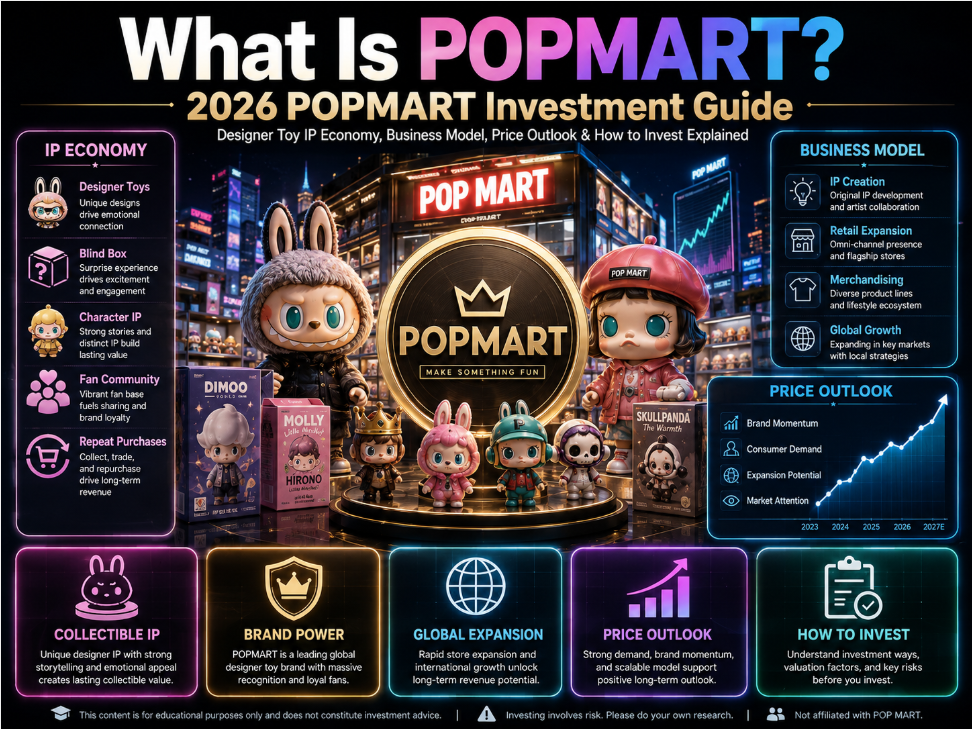
An IP company is different. A successful character can be extended across multiple product lines: figures, keychains, plush toys, building blocks, collaborations, holiday exclusives, convention specials, animated content, live events, and licensing deals.
That’s the power of the IP economy.
Traditional toy model: product‑driven → one‑time sale → inventory management → new products replace old ones.
POPMART model: IP‑driven → series collections → collecting culture → community sharing → repeat consumption → brand premium.
From an investment standpoint, POPMART stands out for three reasons:
- IP drives repurchase. Consumers don’t buy just once – they keep buying different series of the same IP.
- IP expands across categories. A single character can move from blind boxes to plush, apparel, accessories, exhibitions, and licensing.
- IP goes global. If a character resonates across cultures, its market isn’t limited to China – it can reach Asia, Europe, the Americas, and young consumers worldwide.
S&P Global research has also noted that POPMART’s overseas growth is fueled by hit collectibles like LABUBU, with the international revenue share expected to keep rising.
4. How Is POPMART Different From Typical Crypto Assets?
POPMART is first and foremost a real‑world consumer brand. Its value comes from revenue, profits, IP portfolio, brand equity, store networks, customer retention, and global expansion.
Typical crypto assets derive value from blockchain networks, tokenomics, community consensus, protocol revenues, on‑chain usage, or market sentiment.
If you ever see a POPMART‑related tokenized asset, synthetic asset, or market‑linked token in the future, remember: that asset is not POPMART itself, nor is it necessarily equivalent to holding POPMART stock.
Think of it this way:
- POPMART’s company value comes from real‑world operations.
- POPMART stock represents corporate equity in the stock market.
- A POPMART crypto or tokenized stock may represent some form of on‑chain price exposure or asset mapping.
If an asset is tokenized, you must verify: Does it represent actual equity? Is there a custody arrangement? Is there a redemption mechanism? Is it merely a price tracker? Does it have legal protections?
This ties into the broader RWA trend. Crypto markets are exploring how to bring real‑world assets on‑chain – for example, what is FXRP shows how XRP can be used in DeFi lending through asset mapping. Any POPMART digital asset would need to be evaluated using the same RWA and tokenized‑asset framework.
5. POPMART Business Model: Why IP Economy Is the Core Moat
How does POPMART actually make money? Its revenue streams break down into four main areas:
- Blind‑box sales – the flagship model, using series‑based characters, hidden‑item mechanics, and collector psychology to boost engagement and repeat buys.
- IP product sales – beyond blind boxes, POPMART sells figures, plush, building blocks, accessories, lifestyle goods, and limited editions. Strong IPs monetize across multiple formats.
- Retail channels – physical stores, robotic vending machines, online malls, apps, mini‑programs, and cross‑border e‑commerce. The stronger the channel network, the more efficient the IP monetization.
- Overseas expansion – international markets are POPMART’s biggest growth driver in recent years. Its e‑commerce already reaches over 90 countries.
From a valuation perspective, POPMART isn’t just “selling stuff” – it’s using IP to continuously create new consumption scenarios.
6. Why Do IPs Like LABUBU Generate Such Massive Commercial Value?
LABUBU’s virality is the result of design appeal, social sharing, collectible scarcity, and global youth culture converging.
A great IP typically follows this lifecycle:
Character design → consumer recognition → emotional connection → social buzz → collecting demand → series expansion → secondary purchases → long‑term cultural asset.
LABUBU’s success proves that POPMART isn’t selling plastic toys – it’s selling emotional value, collector identity, and social currency.
Many enduring global brands – Disney, Nintendo, Pokémon – derive their lasting value from characters, stories, worlds, and consumer mind‑share, not from a single product.
That said, LABUBU’s popularity also raises a risk: if the market becomes overly dependent on one breakout IP, investors need to judge whether the company can keep incubating new characters, not just ride a single wave. AP reporting also noted that while POPMART’s revenue jumped sharply, concerns remain about growth sustainability and reliance on the LABUBU craze.
7. What Are POPMART’s Moats?
POPMART’s competitive advantages come from four pillars:
- IP development capability – the ability to continuously discover, incubate, and operate new characters. Long‑term value depends on multiple hit IPs, not just one.
- User community – collectibles aren’t functional goods; they’re about displaying, trading, and socializing. An active community extends IP lifecycles.
- Global channels – physical stores, vending machines, online platforms, and cross‑border logistics let POPMART push IPs to global markets quickly. Official data shows its store footprint already spans multiple regions.
- Data capabilities – blind‑box sales, membership, app usage, e‑commerce, and community interactions give POPMART real‑time insight into which IPs are hot, which series have high repurchase rates, and which markets are accelerating.
Over the long run, POPMART’s moat isn’t the blind‑box model – it’s IP creation, channel efficiency, and community operations.
8. What Is a “POPMART Token” or Digital Asset? How to Understand On‑Chain Investment Vehicles?
If you come across a POPMART‑related asset in crypto markets, don’t assume it equals POPMART stock.
These digital assets could take several forms:
- Tokenized equity – aims to mirror POPMART stock price, but you must check if it’s backed by actual shares held in custody, whether you have redemption rights, whether shareholder benefits apply, and whether disclosures are compliant.
- Synthetic asset – tracks price via a synthetic mechanism, without real stock backing.
- Market‑linked token – moves with POPMART’s market price but gives you no ownership.
- Thematic crypto asset – merely uses POPMART, LABUBU, or toy‑culture branding for marketing – no legal relationship with the company.
So ask three questions:
- Does the token represent genuine equity or economic rights?
- Is there audited custody and asset backing?
- Is it just a price tracker or pure hype?
You can check POPMART real‑time quotes for market data, but a price feed alone doesn’t tell you the asset’s legal structure or your rights.
9. POPMART Investment Logic: Where Does the Value Come From?
POPMART’s investment case rests on three pillars:
- Consumer brand value. Traditional companies sell products; brand‑powered companies sell mind‑share and loyalty. If POPMART keeps building strong IPs, it can command a premium over ordinary toy makers.
- Global growth potential. Chinese consumer brands need to prove they can go overseas to unlock higher valuations. POPMART’s international expansion is a key variable. CNA reported that hot IPs like LABUBU and Nezha‑related products are driving overseas growth, and markets are watching whether POPMART can become a global pop‑culture brand.
- Collector and community economics. Collectibles are inherently social – consumers buy not for utility but for display, trading, community participation, and identity. That drives higher retention and stickiness.
If POPMART can keep incubating new IPs, expand overseas channels, broaden its product mix, and manage inventory and trend cycles, it could evolve from a toy brand into a global IP conglomerate.
10. What Drives POPMART’s Price? Key Factors to Watch
Whether you’re analyzing POPMART stock or a tokenized version, you need to separate fundamentals, sentiment, and asset structure.
Fundamentals:
Revenue growth, profit margins, IP sales breakdown, overseas revenue share, inventory levels, store productivity, online performance, and new product traction.
Public filings show POPMART recorded RMB 37.12 billion in revenue for 2025, up 184.7% YoY. That’s explosive – but sustainability matters. What happens after the LABUBU wave? Can new IPs step up?
Market factors:
Consumer spending cycles, youth purchasing power, global macroeconomic conditions, Hong Kong stock market sentiment, and valuation multiples for consumer brands all affect POPMART stock.
Crypto‑market factors:
For tokenized assets, also watch trading liquidity, RWA demand, token structure, custody risk, and on‑chain depth.
IP lifecycle:
The biggest risk for any pop‑culture brand is a “flash in the pan.” Watch whether POPMART is building a multi‑IP portfolio rather than riding one character.
You can view POPMART price prediction for trend references, but always combine that with fundamentals, market cycles, and asset specifics.
11. How to Think About POPMART Price Predictions
There’s no single “right” price target. A more useful approach is scenario analysis:
- Bull case: POPMART sustains high revenue growth; IPs beyond LABUBU gain traction; overseas markets become a strong second leg; and tokenized/RWA interest expands, boosting visibility.
- Base case: Revenue grows but at a slower pace; the market recalibrates valuation; price moves more in line with consumer‑stock fundamentals and sentiment.
- Bear case: LABUBU cools, inventory builds, overseas costs rise, IP innovation stalls, or tokenized assets suffer low liquidity – all putting pressure on price.
So POPMART’s future isn’t just about “is LABUBU still hot?” – it’s about whether the company can transform a breakout hit into a lasting IP portfolio.
12. POPMART and the RWA Trend: How Real‑World Brands Enter Crypto Finance
Why are crypto investors increasingly watching traditional brands?
RWA (Real World Assets) tokenization covers stocks, real estate, commodities, bonds, funds, brand assets, intellectual property royalties, and other financial claims.
Early crypto traded mostly native tokens – BTC, ETH, DeFi tokens, memes. But the future may see more on‑chain representations of real‑world assets.
POPMART fits the RWA discussion because it has three traits:
- User base – a real consumer base and global fan community.
- Cash flow – product sales, store revenue, online income, and IP licensing.
- Brand value – successful IPs are intangible assets that financial markets can price.
This parallels what is AIRH in the AI/robotics asset tokenization space. Going forward, traditional enterprises, consumer brands, AI companies, robotics assets, and IP economies may all become RWA targets.
13. Key Differences Between POPMART and Crypto Asset Investing
Crypto token investment logic typically focuses on:
- Token utility
- Network effects
- Community
- Protocol revenue
- On‑chain activity
- Market liquidity
For a new token like what is FRONG, you’d analyze community buzz, liquidity, contract security, and small‑cap volatility.
Consumer‑brand investing is different. For POPMART, you look at:
- Revenue and profit
- Brand strength
- IP lifecycle
- Global expansion
- Inventory
- Valuation
If POPMART is tokenized, you also need to check:
- Does the token correspond to real assets?
- Is there custody?
- Is there a redemption mechanism?
- Are there legal rights?
- Is there trading liquidity?
- Is it regulatory‑friendly?
The two worlds may converge:
Brand assets → tokenization → global liquidity → on‑chain trading → new access points.
But tokenization does not reduce risk – it only changes how the asset is accessed and traded.
14. Risk Analysis: What to Watch Before Investing
- IP popularity fade – LABUBU, MOLLY, SKULLPANDA may not stay hot forever. Trends shift with social media and youth aesthetics.
- Single‑hit dependency – if revenue relies too heavily on LABUBU, the market will worry about innovation capacity. Monitor whether multiple IPs contribute meaningfully.
- Consumer spending risk – collectibles are discretionary. An economic downturn or weaker youth spending could hurt sales.
- Overseas execution risk – global expansion brings higher store costs, supply‑chain complexity, cultural hurdles, regulatory requirements, and localization costs.
- Counterfeits – popular IPs attract fakes, which can damage brand image and divert demand.
- Valuation risk – if expectations are too high, any earnings miss could trigger sharp price swings.
- Tokenized‑asset risks – for on‑chain POPMART assets, watch custody, legal rights, liquidity, contract security, and platform credibility. Not all POPMART‑named tokens represent real equity.
- Wallet and security risks – crypto investing isn’t just about price. Read about Coldcard hack details to understand why private keys, wallets, contract addresses, and custody matter.
15. Future Trends: IP Economy Meets Digital Assets
Three directions to watch:
- Becoming a global IP company – if POPMART consistently creates characters that resonate worldwide, it could follow Disney, Pokémon, or Sanrio – not a toy retailer.
- Digital collectibles – POPMART may explore NFTs, digital collectibles, online membership communities, gamification, and virtual experiences. Collectibles are inherently digital‑friendly, and digital formats can expand engagement.
- RWA financialization – as more brand assets, IP royalties, stocks, and cash flows are tokenized, POPMART could become a case study for crypto investors exploring RWA.
But this trend requires legal, custody, auditing, exchange, and regulatory infrastructure. Don’t assume a name like “POPMART” on a token means real corporate rights.
16. How to Analyze POPMART as an Investment
A practical framework:
- Company level: revenue sustainability, margin stability, IP diversification, overseas progress, inventory health, store productivity.
- IP level: lifecycle management – one hit can last a year, but a multi‑year IP matrix with new characters, stories, and product lines is far more valuable.
- Globalization level: overseas stores, cross‑border e‑commerce, international community, local collaborations, and cultural adaptation.
- Asset structure: if buying stock, study valuation, earnings, and HK market conditions. If buying a tokenized asset, verify backing, custody, redemption, legal protections, and liquidity.
- Market cycles: consumer stocks, Hong Kong equities, crypto, and RWA all move in cycles. POPMART‑related assets are not immune to sentiment shifts.
17. Key Business Metrics to Track
To make this guide more actionable, here are the data points to monitor:
- Revenue Growth – annual revenue, YoY growth, quarterly trends, and sources. Strong growth shows IP monetization works, but sustainability is key.
- Global Stores – total physical stores, robotic vending units, new country coverage, and store expansion pace. This determines whether POPMART becomes a true global IP company.
- IP Portfolio – revenue contribution by IP (LABUBU, MOLLY, SKULLPANDA, CRYBABY, etc.). Multiple growing IPs are healthier than one blockbuster.
- Market Cap – POPMART stock valuation vs. peers. A great company can still be a bad investment if priced too high.
- Liquidity – trading volume, bid‑ask depth, available platforms, and overall market liquidity – especially critical for tokenized assets.
- Price History – past performance, major rallies and pullbacks, and post‑earnings reactions. Volatility often reflects repricing of growth and risk.
18. RWA Comparison: POPMART Company vs. Stock vs. Tokenized Asset
- POPMART (the company) – a real‑world business with IPs, products, stores, employees, revenue, and profits. Value comes from operations.
- POPMART stock – an equity asset traded on securities exchanges, regulated by stock market rules.
- POPMART tokenized asset – an on‑chain digital instrument that may track the stock price or related exposure. Whether it grants actual rights depends on its issuance structure.
- POPMART crypto “concept” asset – may just use the brand name or price correlation, with no legal tie to the company. Highest risk – always verify contract, issuer, and asset backing.
This distinction is critical. Many newcomers see a “POPMART‑USDT” pair and assume they’re buying shares. In reality, any on‑chain or exchange‑listed asset must be examined for its actual structure.
19. FAQ: Common Questions About POPMART Investing
What is POPMART?
POPMART is a designer toy company focused on collectible IP, blind boxes, retail channels, and global pop‑culture branding. In Chinese, it’s 泡泡玛特 – a consumer brand built around art toys, IP operations, and omni‑channel retail.
Is POPMART a cryptocurrency?
No. POPMART is a consumer brand company. If you see “POPMART crypto” or “POPMART tokenized stock,” verify whether it represents real equity, has custody and redemption, or is just a price‑tracking or thematic token.
How to invest in POPMART?
For traditional stock, use a brokerage that supports Hong Kong equities. For tokenized assets, trade on platforms that support them – but always check the asset structure, liquidity, and legal rights. You can observe market prices via POPMART real‑time quotes.
Is POPMART stock a buy?
That depends on revenue growth, margins, IP lifecycle, overseas execution, valuation, and your own risk tolerance. POPMART’s revenue growth is strong, but watch whether LABUBU’s momentum can be sustained and whether new IPs emerge – and whether the stock already prices in that growth.
What’s the relationship between POPMART and LABUBU?
LABUBU is one of POPMART’s hottest IPs. Its global success boosted POPMART’s brand and overseas profile. But investors should assess whether the company can launch multiple successful IPs, not rely on a single hit.
How should I read POPMART price predictions?
Combine fundamentals, IP trends, overseas growth, consumer cycles, HK market sentiment, and asset structure. You can check POPMART price prediction for reference – but never treat any prediction as guaranteed returns.
Is POPMART an RWA?
The company itself is not an RWA token. But if its stock, brand assets, or related exposure are tokenized, they fall under RWA/tokenized‑asset discussions. Always verify whether the token has real asset backing.
Where does POPMART’s future potential come from?
Global IP expansion, a multi‑IP portfolio, overseas market growth, digital collectibles, and asset financialization. Risks include IP fatigue, consumer cycles, counterfeits, valuation pressures, and opaque token structures.
20. Summary: Is POPMART Worth Investing In?
POPMART deserves attention – but don’t oversimplify it as “LABUBU is hot, so buy.”
Strengths:
- It has evolved from a toy retailer into an IP operator.
- LABUBU and others prove global appeal.
- Blind boxes, collecting, community, and social sharing drive retention and brand stickiness.
- Overseas expansion opens long‑term runway.
- If tokenized stock or RWA versions emerge, it could be a flagship case of a consumer brand going on‑chain.
Risks:
- IP trends can cool.
- Over‑reliance on a few hits is a real concern.
- Consumer spending and HK valuations are cyclical.
- Global expansion requires sustained investment.
- For crypto‑style assets, custody, legal rights, liquidity, and platform risk are extra layers.
For beginners, build a three‑layer framework:
- Fundamentals – revenue, profits, IP mix, overseas markets, channel expansion.
- Asset structure – are you buying stock, tokenized stock, or a loosely themed token?
- Market cycles – consumer valuations, crypto liquidity, RWA sentiment, and overall risk appetite.
A rational approach: start with POPMART real‑time quotes for market data, then cross‑reference with POPMART price prediction, along with reads on FXRP, AIRH, FRONG, and the Coldcard security deep‑dive to build a well‑rounded view of RWA, crypto assets, and secure investing.
POPMART’s long‑term value ultimately hinges on whether it can evolve from a hit‑driven toy brand into a lasting global IP company. For investors, the real question isn’t “how long will blind boxes stay popular?” – it’s whether POPMART can keep creating cultural assets, monetizing IP across formats, and bridging the physical consumer world with digital‑asset opportunities.